
In this post, you will learn about the virtues, spiritual benefits, and historical background of the last two verses of Surah Al-Baqarah in the light of hadith. These are verses 285 and 286 of Surah Al-Baqarah, found in the third Juz (section) of the Qur’an. They are among the most blessed and powerful verses of the Holy Qur’an, carrying profound lessons about faith, Allah’s mercy, forgiveness, patience, heartfelt supplication, and seeking Allah’s help during times of difficulty.
Before the revelation of these final two verses, Allah Almighty stated in verse 284 of Surah Al-Baqarah:
“To Allah belongs whatever is in the heavens and whatever is on the earth. Whether you reveal what is within yourselves or conceal it, Allah will call you to account for it.”
When the Companions (may Allah be pleased with them) heard this verse, they became deeply worried. They felt that if Allah were to hold them accountable for every thought, intention, or feeling that crossed their hearts, it would become extremely difficult for them, as a person does not always have complete control over every passing thought.
With this concern weighing heavily upon them, the Companions came to the Prophet صلی اللہ علیہ وسلم and shared their worries. They humbly explained that prayer, fasting, striving in the way of Allah, and other commands had already been made obligatory upon them, and they sincerely tried to fulfil these duties. Still, the matter of inner thoughts felt especially difficult.
At this moment, the Prophet صلی اللہ علیہ وسلم guided them with wisdom and reassurance. He advised them not to respond with hesitation, but instead to say:
“We hear, and we obey. Our Lord, we seek Your forgiveness.”
The Companions accepted this guidance with sincerity and chose the path of obedience and submission to Allah. When Allah saw their willingness to obey and their sincere faith, He revealed the last two verses of Surah Al-Baqarah.
Through these blessed verses, Muslims were given reassurance that unintentional thoughts and involuntary whispers of the heart would not be counted as sins, because Allah fully understands human weakness and knows the limits of what a person can bear. These verses brought great comfort to believers, reminding them that Allah’s mercy and compassion are always greater than their fears and struggles.
Last 2 Verses of Surah al-Baqarah in Arabic
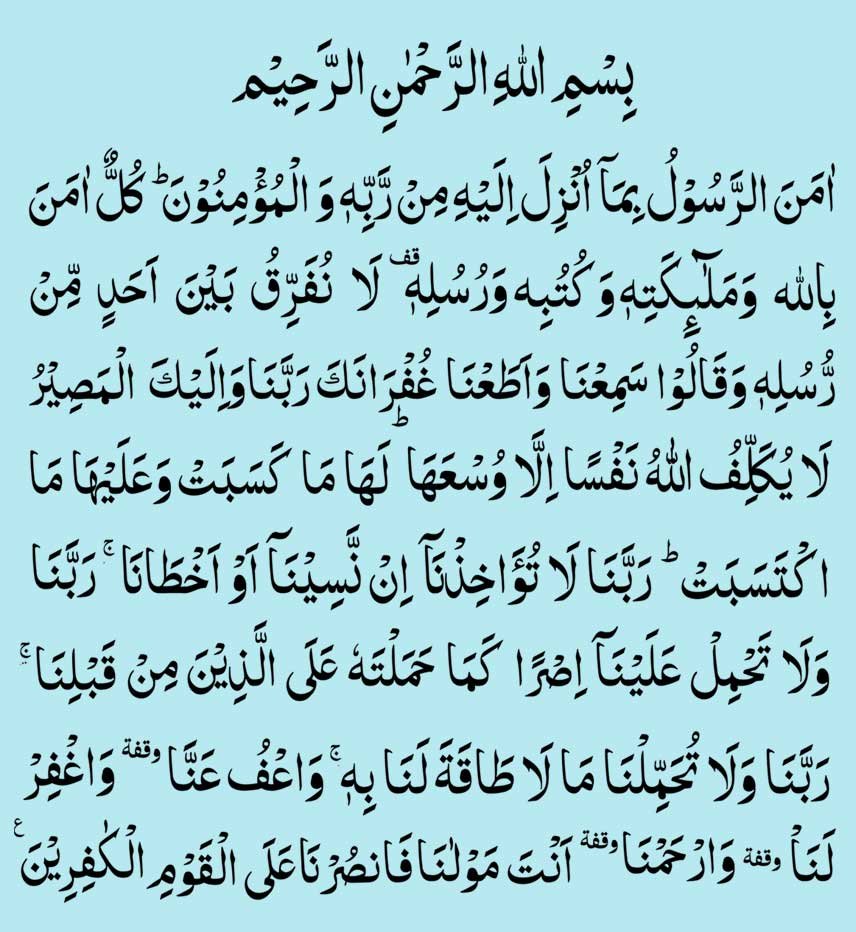
Last 2 Verses of Surah al-Baqarah Translation
Verse 285:
“The Messenger has believed in what was revealed to him from his Lord, and so have the believers. All of them have believed in Allah, His angels, His books, and His messengers, saying, ‘We make no distinction between any of His messengers.’ And they say, ‘We hear, and we obey. Grant us Your forgiveness, our Lord, and to You is the final return.’”
Verse 286:
“Allah does not burden a soul beyond what it can bear. It will have the reward of what good it has earned, and it will bear the burden of what evil it has committed. Our Lord, do not take us to task if we forget or make a mistake. Our Lord, do not place upon us a burden like that which You placed upon those before us. Our Lord, do not burden us with what we do not have the strength to bear. Pardon us, forgive us, and have mercy on us. You are our Protector, so grant us victory over the disbelieving people.”
These are the last two verses of Surah Al-Baqarah and are highly revered in Islam for protection, mercy, and spiritual blessings.
Last 2 Verses of Surah al-Baqarah in English
Last 2 Verses of Surah Al-Baqarah in English Transliteration (Roman Arabic)
Verse 285:
Aamanar-Rasoolu bimaa unzila ilaihi mir-Rabbihi wal-mu’minoon. Kullun aamana billaahi wa malaa’ikatihi wa kutubihi wa rusulih, laa nufarriqu baina ahadim mir-rusulih. Wa qaaloo sami‘naa wa ata‘naa ghufraanaka Rabbanaa wa ilaikal-maseer.
Verse 286:
Laa yukallifullaahu nafsan illaa wus‘ahaa. Lahaa maa kasabat wa ‘alaihaa maktasabat. Rabbanaa laa tu’aakhiznaa in naseenaa aw akhta’naa. Rabbanaa wa laa tahmil ‘alainaa isran kamaa hamaltahoo ‘alal-lazeena min qablinaa. Rabbanaa wa laa tuhammilnaa maa laa taaqata lanaa bih. Wa‘fu ‘annaa waghfir lanaa warhamnaa. Anta Mawlaanaa fansurnaa ‘alal-qawmil-kaafireen.
Last 2 Verses of Surah Al-Baqarah Hadith
According to Sahih Muslim, Abdullah ibn Abbas (may Allah be pleased with him and his father) narrated that once Angel Jibreel (Gabriel, peace be upon him) was sitting with the Prophet Muhammad (صلی اللہ علیہ وسلم) when suddenly a sound was heard from above. Jibreel (peace be upon him) said:
“This is a gate of heaven that has been opened today and has never been opened before.”
Then an angel descended through it and said:
“Receive glad tidings of two lights that have been given to you, which were not given to any prophet before you: Surah Al-Fatiha and the last verses of Surah Al-Baqarah. You will never recite a letter from them except that you will be granted what is contained in it.”
Reference:
Sahih Muslim, Book of Prayer for Travelers (Kitab Salat al-Musafirin), Hadith 806
According to Sahih al-Bukhari, Abu Mas‘ud Al-Badri (may Allah be pleased with him) narrated that the Prophet Muhammad (peace and blessings be upon him) said:
“Whoever recites the last two verses of Surah Al-Baqarah at night, they will be sufficient for him.”
Reference:
Sahih al-Bukhari, Hadith 5009
Sahih Muslim, Hadith 808
Last 2 Verses of Surah al-Baqarah Wazifa
The last two verses of Surah Al-Baqarah may serve as a source of solace for many believers, offering relief from life’s hardships. If you are going through a difficult time, then reciting these blessed verses as a spiritual practice (wazifa) may, by the mercy of Allah, help bring ease, relief, and acceptance of your prayers. Many traditional Islamic books mention different methods of reciting the last two verses of Surah Al-Baqarah as a spiritual routine (wazifa), and in this post, you will find one of the simplest and most widely practised methods (wazifa).
If you would like to recite the last two verses of Surah Al-Baqarah as a wazifa, begin on Friday after the Isha prayer by reciting 10 salutations upon the Prophet صلى الله عليه وسلم.
After this, offer two voluntary prayers (nafl). In each unit of prayer, recite Surah Al-Fatiha followed by Surah Al-Ikhlas three times.
Once the voluntary prayers (nafl) are complete, recite “Astaghfirullah Rabbi Min Kulli Zambiyon Wa Atubu ilaih” 10 times. Then, recite the last two verses of Surah Al-Baqarah 70 times with sincerity and focus.
Finally, complete the practice (Wazifa) by once again reciting 10 salutations upon the Prophet صلى الله عليه وسلم. This spiritual routine (Wazifa) should only be performed after the Isha prayer and continued for at least 14 days.
Once the 14 days are complete, try to make it a daily habit to recite 10 salutations upon the Prophet صلى الله عليه وسلم and at least one recitation of the last two verses of Surah Al-Baqarah every day. By the will of Allah, you may soon begin to experience relief from your present worries, difficulties, and hardships.
It is important to remember that the spiritual practice mentioned here is based on the experiences and observations of some pious elders. If a Muslim has time after fulfilling their obligatory acts of worship, they may choose to practise it. According to the experiences shared by righteous people, this recitation may become a source of many spiritual and worldly blessings. Below, we have briefly explained some of the commonly experienced benefits associated with this practice(wazifa).
Last 2 Verses of Surah al-Baqarah Wazifa Benefits
If a Muslim brother or sister chooses to regularly recite (wazifa) the last two verses of Surah Al-Baqarah as a spiritual practice (wazifa), they may experience many spiritual and practical blessings through it.
In this post, we will share some of the commonly observed benefits of this recitation (wazifa).
It is important to remember that receiving benefits from any spiritual practice (wazifa) depends upon a person’s sincere intention, lawful purpose, and the will of Allah.
Since every believer’s spiritual nature and experience are different, the blessings of this recitation may also appear in different ways for different people.
By the blessing of reciting verses 285 and 286 of Surah Al-Baqarah, a person may, by the mercy of Allah, find quick relief from financial hardship, debt, and difficult times.
Those who are unemployed may find good employment opportunities, while others may be blessed with a job that matches their personal preference and circumstances.
This recitation (wazifa) may also be practised (wazifa) with the intention of success in job interviews, finding employment, or gaining business success.
By the blessing of this spiritual practice (wazifa), some Muslims have also experienced relief from depression, anxiety, and feelings of panic or emotional distress.
Reciting these verses may, by the will of Allah, help remove fear and bring comfort to the heart.
This recitation (wazifa) may also become a means of removing obstacles in marriage for Muslim brothers and sisters.
Some people believe that, through Allah’s mercy, it may help make the path to marriage easier.
Many couples also recite these verses with the hope of increasing love and harmony between husband and wife, helping reduce misunderstandings and unnecessary doubts within the relationship.
Some Muslims recite these verses while praying for children, hoping Allah blesses them with righteous offspring.
In earlier times, these verses were also commonly recited for protection during pregnancy.
By the blessing of these verses, some Muslims believe they may become a means of protection from the evil eye, harmful influences, enemies, negative effects, and evil whispers.
The recitation of the last two verses of Surah Al-Baqarah may also become a means of bringing peace, comfort, and emotional security into a Muslim’s life.
It is mentioned in a hadith that whoever recites the last two verses of Surah Al-Baqarah at night, they will be sufficient for them. Some scholars explain this to mean that Allah protects His servant from many hardships, harms, and troubling whispers.
These verses are filled with beautiful meanings of Allah’s mercy, forgiveness, and ease. Therefore, when a believer recites them sincerely and turns to Allah in prayer, their hope in the acceptance of supplication naturally becomes stronger.
Many Muslims include these verses in their daily routine because their recitation often brings a feeling of spiritual peace, blessings, and positivity into the home environment.
At the same time, it should be remembered that reciting the last two verses of Surah Al-Baqarah is not a substitute for obligatory worship. Rather, it is a spiritual practice that is best observed alongside daily prayers, supplications, and recitation of the Qur’an, while sincerely asking Allah for goodness, blessings, and ease in life.